B03_scatter_3Dxyz_bspline Test
测试目标
tests/004_scatter/B03_scatter_3Dxyz_bspline 是
B03_scatter_3Dxyz_bspline
的直接 scatter 回归测试。它测试的是完整粒子到网格沉积路径,而不只是
B-spline 权重函数:
order=1时,B03 是否退化为 B01 的 CIC/三线性 scatter。粒子数沉积是否保持总量
sum(den)=np*w。粒子分量沉积是否保持总量
sum(den)=w*sum(par(d,:))。order>=1时,沉积后的一阶矩是否等于粒子位置加权和。den是否保持累加语义,即分批沉积和一次性沉积结果一致。
本测试不覆盖边界条件、周期折叠、MPI guard-cell 交换或多物种归一化系数。
覆盖接口
sub_B03_scatter_3Dxyz_bspline:被测顶层粒子数沉积接口。sub_B03_scatter_3Dxyz_bspline_v:被测顶层粒子分量沉积接口。sub_B03_bspline_stencil_1d和fun_B03_bspline_shape:通过顶层沉积间接覆盖。sub_B01_scatter_3Dxyz和sub_B01_scatter_3Dxyz_v:只在order=1子测试中作为参考。
文件说明
文件 |
作用 |
|---|---|
|
构造确定性粒子,运行 B01 对比、总量守恒、一阶矩和累加语义测试。 |
|
读取 Fortran 写出的比较行,统计误差、判断 PASS/FAIL,并生成参考图。 |
|
使用 |
|
清理旧运行结果、编译、运行 Fortran 程序并执行 Python 后处理。 |
|
删除测试目录中的编译产物、运行时结果和 Python 缓存。 |
运行方式
cd tests/004_scatter/B03_scatter_3Dxyz_bspline
bash run.sh
测试设计
Fortran 程序使用固定的 64 个粒子,粒子位置全部放在可访问网格范围内,避免边界处理影响 B-spline 公式本身的判断。每个子测试写出一行或多行比较指标,包含参考值、实际值、绝对误差和阈值。 Python 后处理逐行判断,只要任意一行超过阈值就返回失败。
order=1 对 B01 的逐网格点比较用于检查低阶极限。总量守恒检查用于确认权重归一化。
一阶矩检查用于确认 order>=1 的形函数在沉积意义下能保持粒子位置。分批累加检查用于确认
den 是真正的累加目标,而不是在子程序内部被重新初始化。
子测试说明
子测试 |
阶数 |
判断方式 |
|---|---|---|
|
|
B03 粒子数沉积与 B01 CIC 沉积逐网格点比较。 |
|
|
B03 |
|
|
检查粒子数沉积满足 |
|
|
检查分量沉积满足 |
|
|
检查 |
|
|
检查一阶矩是否等于 |
|
|
两批粒子沉积结果与一次性粒子数沉积逐网格点一致。 |
|
|
两批粒子沉积结果与一次性分量沉积逐网格点一致。 |
结果判断
source_py/analyze.py 使用 Fortran 输出中的逐行阈值判断结果:
指标类型 |
阈值 |
说明 |
|---|---|---|
B01 对比 |
|
|
总量守恒 |
|
权重归一化后,总沉积量应保持。 |
一阶矩 |
|
|
分批累加 |
|
分批沉积和一次性沉积应逐点一致。 |
参考运行结果:
rows          : 38
component_accumulation    : max_abs=3.469e-18, tol=1.0e-12, rows=1
component_conservation    : max_abs=2.487e-14, tol=1.0e-11, rows=5
component_first_moment    : max_abs=2.274e-13, tol=1.0e-10, rows=12
number_accumulation       : max_abs=6.939e-18, tol=1.0e-12, rows=1
number_conservation       : max_abs=1.776e-14, tol=1.0e-11, rows=5
number_first_moment       : max_abs=3.126e-13, tol=1.0e-10, rows=12
order1_b01_component      : max_abs=5.551e-17, tol=1.0e-12, rows=1
order1_b01_number         : max_abs=0.000e+00, tol=1.0e-12, rows=1
failures      : 0
result        : PASS
参考图
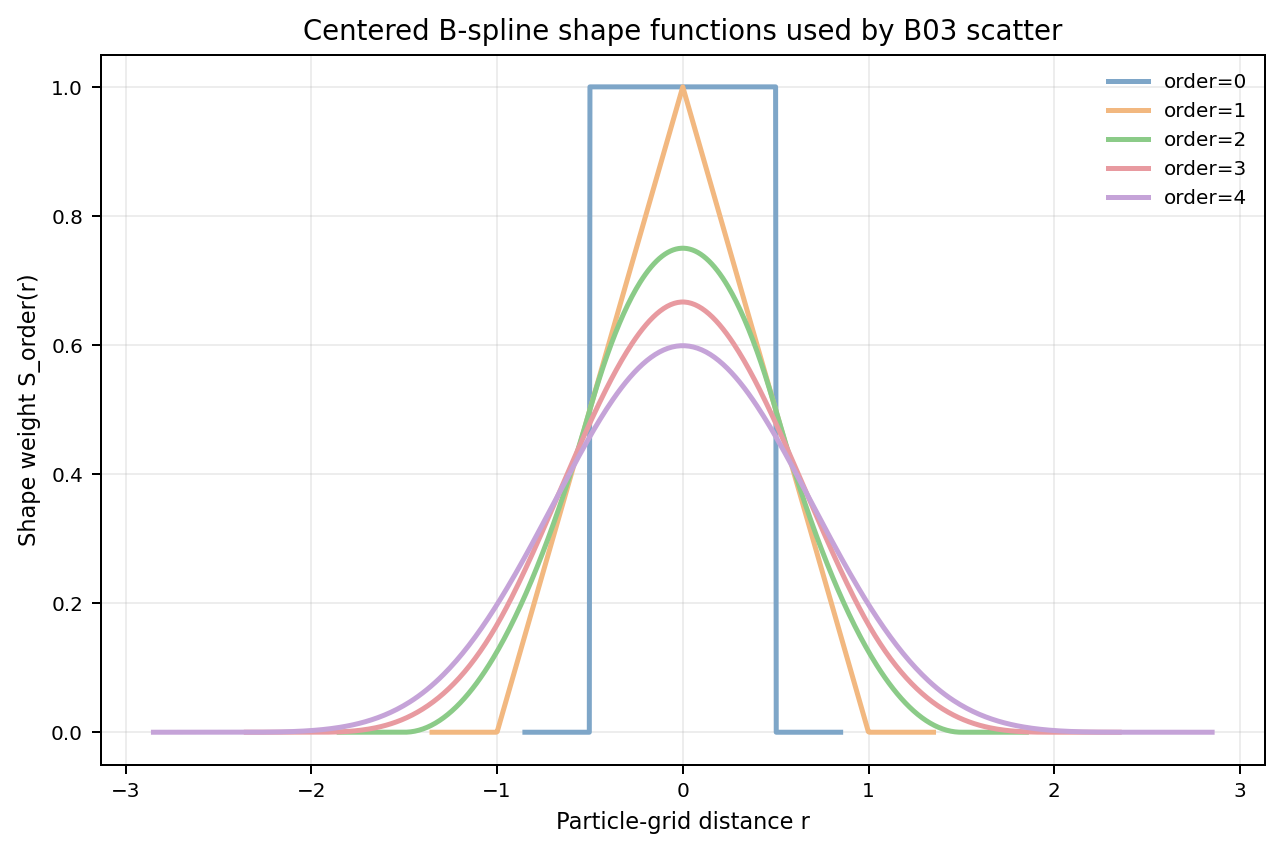
b03_bspline_scatter_shape_curves.png:不同 order 的中心化
B-spline 形函数曲线。横轴为粒子到网格点的距离 \(r\),纵轴为权重
\(S_{order}(r)\)。阶数越高,支撑范围越宽,曲线越平滑。
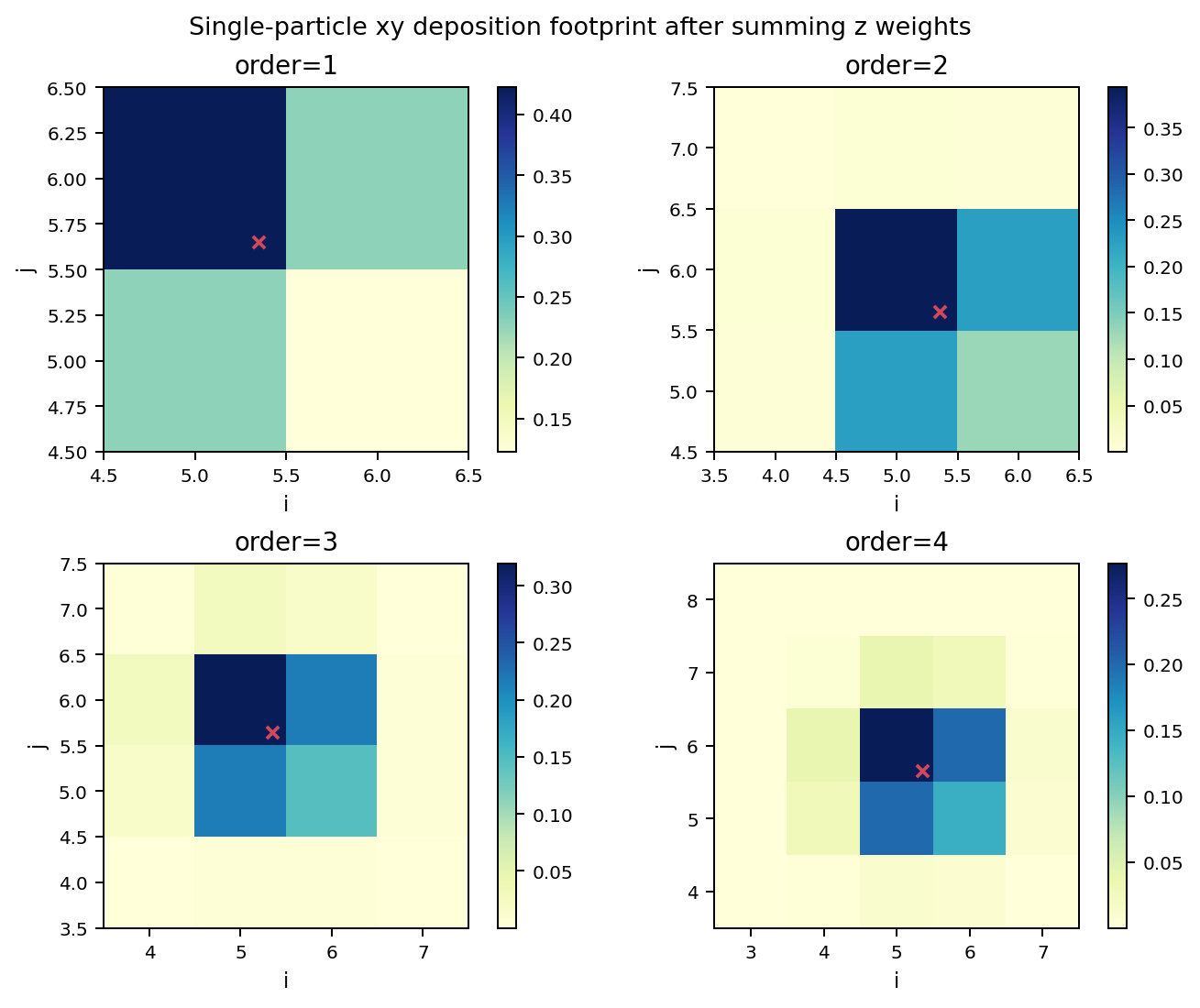
b03_bspline_scatter_single_particle_footprint.png:单个粒子的 xy
沉积 footprint,图中已经对 z 方向权重求和。它展示了随着 order 增加,
一个粒子的源项会分配到更多网格点上。
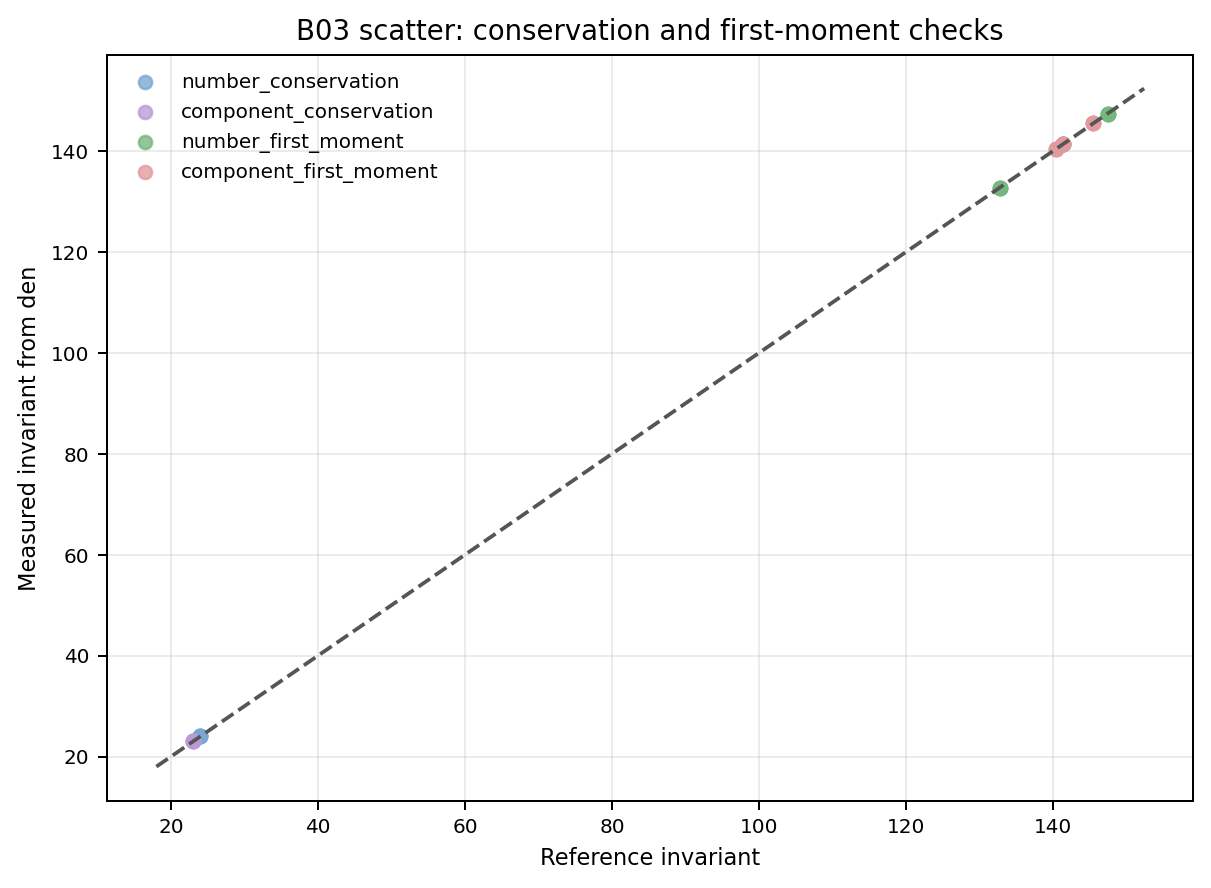
b03_bspline_scatter_ref_vs_value.png:横轴为理论参考不变量,纵轴为
从 den 计算得到的不变量。虚线为 value=reference。总量守恒和一阶矩子测试
都落在对角线附近,说明沉积结果满足对应不变量。
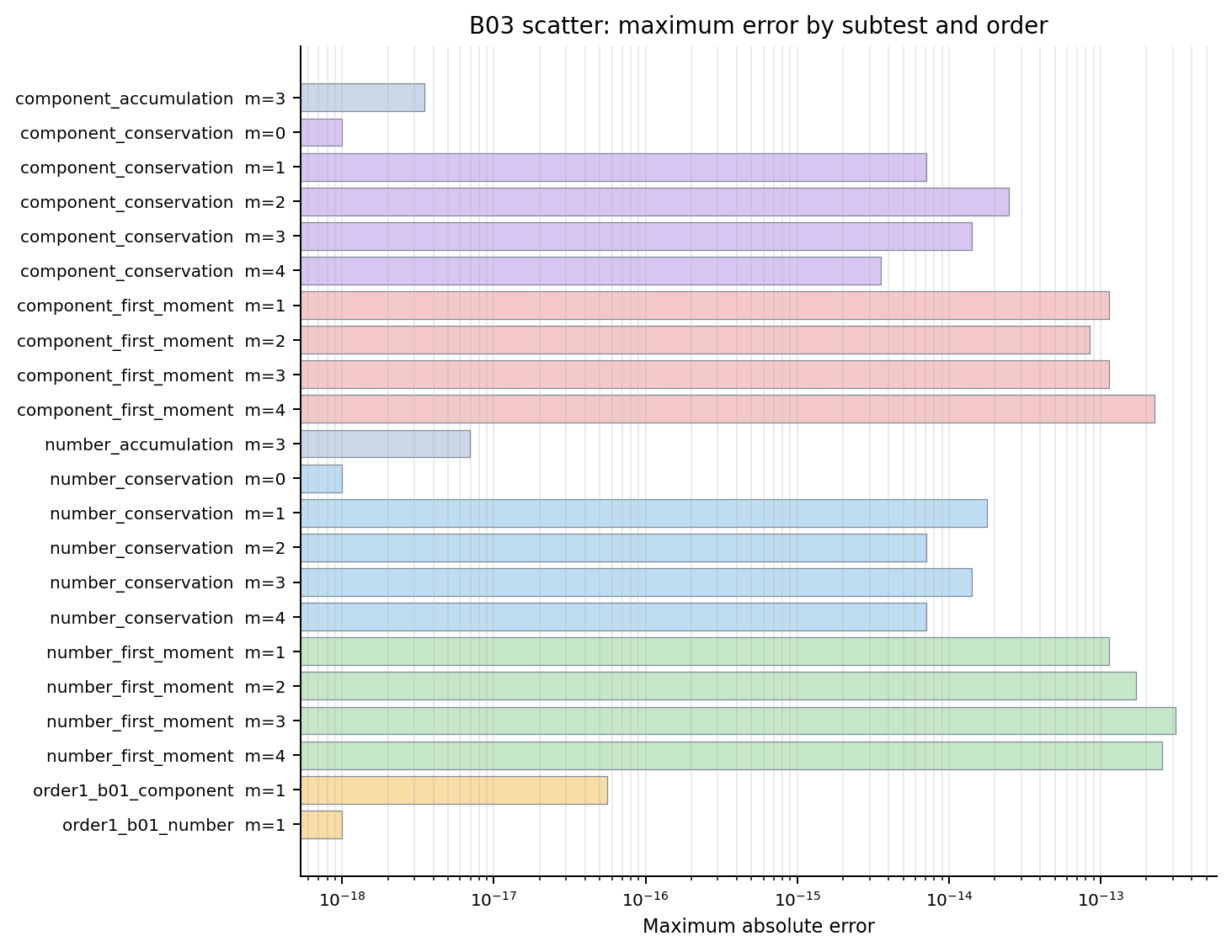
b03_bspline_scatter_errors.png:按子测试和阶数统计最大绝对误差。横轴为对数坐标。
高阶误差略大来自递归求值、模板点增加和三维乘加次数增加后的双精度舍入累积;图中误差仍远低于阈值,
不表示高阶 scatter 公式变差。
常见误读
order=0不检查一阶矩,因为零阶 top-hat 不具备线性一阶矩保持性质。den不在子程序内部清零是设计选择,方便多批粒子或多物种累加。本测试假定 stencil 位于可访问数组范围内,不检验 guard-cell 通信和边界处理。
Test Goal
tests/004_scatter/B03_scatter_3Dxyz_bspline is the direct scatter
regression test for
B03_scatter_3Dxyz_bspline.
It tests the full particle-to-grid deposition path, not only the B-spline
weight function:
Whether
order=1reduces to the B01 CIC/trilinear scatter.Whether particle-number deposition preserves
sum(den)=np*w.Whether component deposition preserves
sum(den)=w*sum(par(d,:)).Whether
order>=1preserves the first moment of the deposited source.Whether
denkeeps accumulation semantics, so split deposition matches one full deposition.
The test does not cover boundary conditions, periodic folding, MPI guard-cell exchange, or multi-species normalization factors.
Covered Interfaces
sub_B03_scatter_3Dxyz_bspline: top-level particle-number deposition interface under test.sub_B03_scatter_3Dxyz_bspline_v: top-level particle-component deposition interface under test.sub_B03_bspline_stencil_1dandfun_B03_bspline_shape: covered indirectly through the top-level deposition routines.sub_B01_scatter_3Dxyzandsub_B01_scatter_3Dxyz_v: used only as references in theorder=1subtests.
Files
File |
Role |
|---|---|
|
Builds deterministic particles and runs B01 comparison, total-conservation, first-moment, and accumulation tests. |
|
Reads comparison rows written by Fortran, summarizes errors, determines PASS/FAIL, and generates reference figures. |
|
Compiles the test program with |
|
Cleans previous run products, builds, runs the Fortran program, and executes the Python postprocessor. |
|
Removes build products, runtime results, and Python cache files from the test directory. |
Run Command
cd tests/004_scatter/B03_scatter_3Dxyz_bspline
bash run.sh
Test Design
The Fortran program uses 64 deterministic particles whose positions all keep the stencil inside the accessible grid range. This isolates the B-spline formula from boundary handling. Each subtest writes one or more comparison rows containing a reference value, measured value, absolute error, and tolerance. The Python postprocessor checks every row and fails if any row exceeds its tolerance.
The order=1 B01 comparison checks the low-order limit. Total
conservation checks weight normalization. The first-moment checks verify
that order>=1 preserves particle positions in the deposition sense. The
split-accumulation checks confirm that den is a true accumulation
target and is not reinitialized inside the subroutine.
Subtests
Subtest |
Orders |
Check |
|---|---|---|
|
|
Compare B03 number deposition against B01 CIC deposition pointwise. |
|
|
Compare B03 |
|
|
Check particle-number deposition with |
|
|
Check component deposition with |
|
|
Check that the first moments in |
|
|
Check that the first moments equal |
|
|
Check that two split particle-number deposition calls match one full call pointwise. |
|
|
Check that two split component-deposition calls match one full call pointwise. |
Result Criteria
source_py/analyze.py uses the per-row tolerances written by the Fortran
program:
Metric type |
Tolerance |
Meaning |
|---|---|---|
B01 comparison |
|
|
Total conservation |
|
After weight normalization, total deposited amount should be preserved. |
First moment |
|
|
Split accumulation |
|
Split deposition and one full deposition should match pointwise. |
Reference run:
rows          : 38
component_accumulation    : max_abs=3.469e-18, tol=1.0e-12, rows=1
component_conservation    : max_abs=2.487e-14, tol=1.0e-11, rows=5
component_first_moment    : max_abs=2.274e-13, tol=1.0e-10, rows=12
number_accumulation       : max_abs=6.939e-18, tol=1.0e-12, rows=1
number_conservation       : max_abs=1.776e-14, tol=1.0e-11, rows=5
number_first_moment       : max_abs=3.126e-13, tol=1.0e-10, rows=12
order1_b01_component      : max_abs=5.551e-17, tol=1.0e-12, rows=1
order1_b01_number         : max_abs=0.000e+00, tol=1.0e-12, rows=1
failures      : 0
result        : PASS
Reference Figures
b03_bspline_scatter_shape_curves.png: centered B-spline shape
functions for different order values. The x-axis is the
particle-grid distance \(r\); the y-axis is the weight
\(S_{order}(r)\). Higher order gives wider support and smoother
curves.
b03_bspline_scatter_single_particle_footprint.png: xy deposition
footprint of one particle after summing the z weights. It shows that a
higher order distributes one particle source to more grid points.
b03_bspline_scatter_ref_vs_value.png: theoretical invariant on the
x-axis and the invariant computed from den on the y-axis. The dashed
line is value=reference. Conservation and first-moment subtests lie
close to the diagonal, showing that the deposited grid field satisfies
the corresponding invariants.
b03_bspline_scatter_errors.png: maximum absolute error grouped by
subtest and order. The x-axis is logarithmic. Slightly larger
high-order errors come from recursive evaluation, larger stencils, and
more 3D multiply-add operations. The errors remain far below the
tolerances, so this is not a degradation of the high-order scatter
formula.
Common Misreadings
order=0does not run first-moment checks because the zero-order top-hat shape does not preserve linear moments.dennot being zeroed inside the subroutine is intentional; it supports multiple particle batches or species.This test assumes the stencil lies inside the accessible array range; it does not test guard-cell communication or boundary handling.